Search
"We are clearly committed to Germany as a business location"
RUD lifting and lashing equipment is synonymous with the highest quality ‘Made in Germany’, thanks to our high degree of vertical integration with German partners and suppliers
Bureaucratic over-regulation, high energy prices, high taxes and levies, and a growing shortage of skilled workers are all issues that Germany is currently facing. Germany’s position as an industrial location is currently being met with a lot of criticism. An increasing number of companies are considering moving their production sites abroad. Even long-established family businesses are contemplating this step. Several well-known companies have already announced plant closures and the imminent opening of new locations abroad. The exodus of key industries, often exaggeratedly referred to as ‘de-industrialisation’, has become a spectre haunting economic and political debates.
Technical knowledge and craftsmanship are both decisive location factors
However, thoughts of relocation are not an issue at RUD’s production facility for lifting and lashing solutions. “We are unequivocally committed to Germany as a location and to the ‘Made in Germany’ quality promise,” says Hermann Kolb, Head of the Lifting and Lashing Equipment Division in the RUD Group. This is emphasised by the high level of vertical integration at the Aalen-Unterkochen headquarters and the long-standing collaboration with local partners. “To ease the pressure on us, we do have some of our products manufactured by partner companies based exclusively in Germany that work precisely to our specifications,” says Kolb. “However, most of our production takes place at our main factory.” The Aalen facility primarily receives semi-finished products, which are sourced exclusively from German manufacturers. The rest is done on the Isle of Peace. This is supported by high-quality, highly automated machinery, and the expertise and experience of RUD engineers and production staff. “The excellent technical knowledge and outstanding craftsmanship of our employees here in the Ostalb region are invaluable to us,” says Hermann Kolb, making it clear just how important the location is. “We also have a state-of-the-art production facility here. These are two areas on which we consciously focus, because the family-owned company RUD has been committed to the highest quality standards for over 150 years, and that commitment will continue into the future.”
An example of high vertical integration: five manufacturing steps are required to produce a VWBG load ring
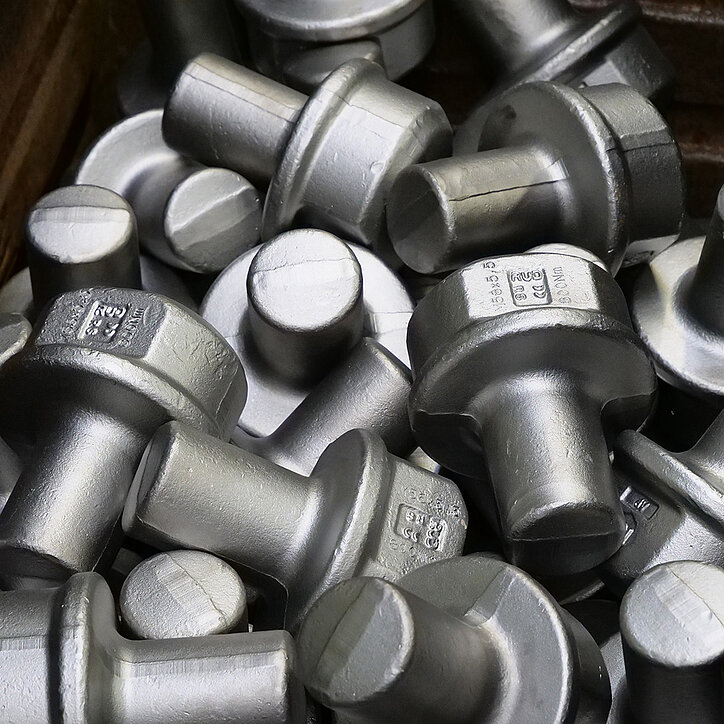
This is particularly significant in the manufacture of VWBG load rings, which facilitate shock-free turning and rotating during lifting operations and are among RUD’s most popular products. Strict care is taken in advance to ensure that only the highest-quality steel grades are used here. The forged blanks that arrive at the main plant in Aalen-Unterkochen are sourced exclusively from German suppliers, with many of them being prefabricated in RUD’s own forging works. RUD specifies the type and grade of steel precisely. The base material alone sets a high quality standard that many products manufactured internationally find difficult to achieve.
Machining the blanks
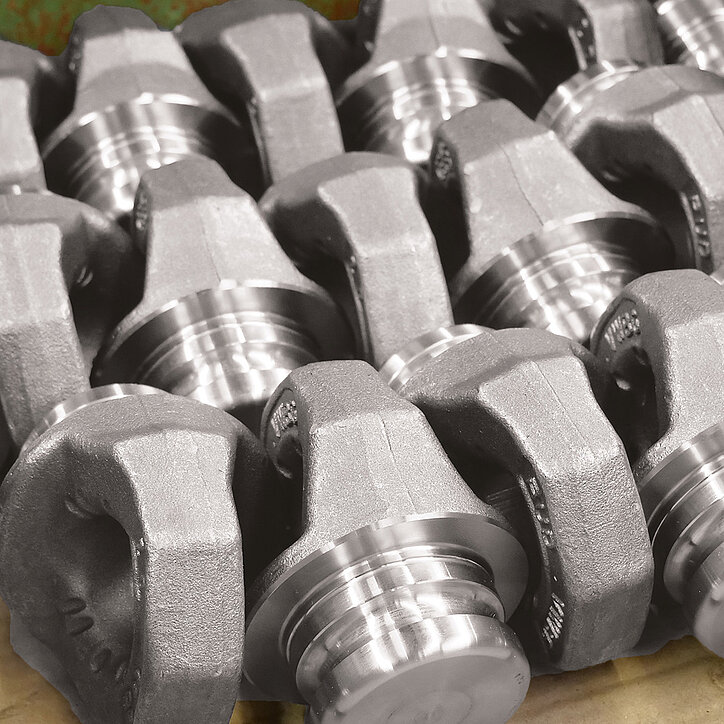
Once the semi-finished products have been delivered to the Isle of Peace, the actual manufacturing process can begin. The next step is the mechanical processing of the blanks. They already feature the basic geometry of the final product, including the ring pins for attaching the suspension link and the detailed manufacturer’s stamp. Further contours are then created using state-of-the-art CNC turning and milling machines. This includes the creation of raceways for the subsequent ball bearings in the main body. At the same time as the ring pin is being mechanically processed, its functional counterpart, the threaded ring, is also being machined. The final contours are thereby produced based on a cylindrical forged part. In addition, both components undergo meticulous checks to ensure dimensional accuracy, to verify that the actual dimensions correspond exactly to the target dimensions and that the permissible deviation tolerance range has been adhered to.
From steel bar to suspension link: the bending and welding process
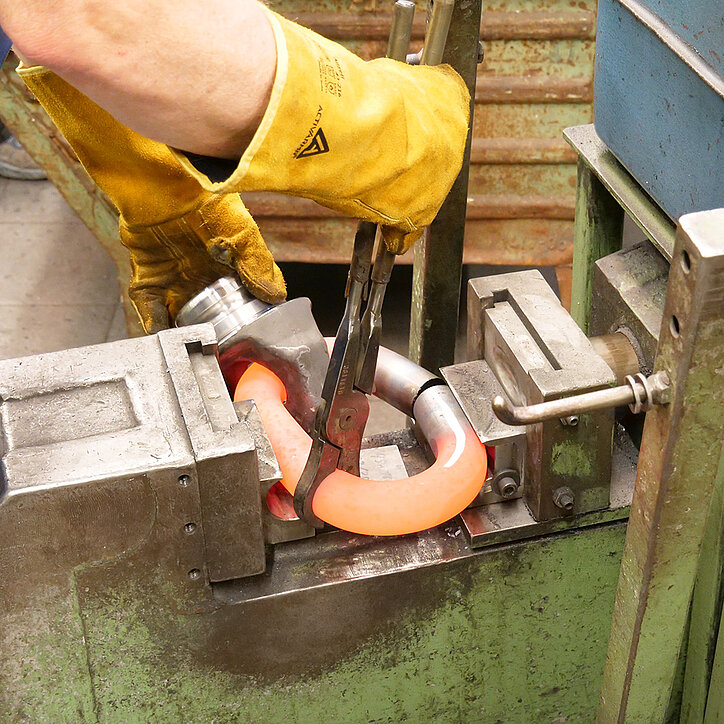
The next step is probably the most spectacular part of the production process for outsiders: the manufacture of the suspension links, which are firmly connected to the lifting eyes. Steel bars of the appropriate length have been cut in advance for use. Once inserted into the eye, it is heated inductively before being bent into the desired shape using hydraulic force. The bent ends are then joined together firmly using resistance and flash butt welding. At RUD, this entire bending and joining process is carried out using high-performance machines and equipment, which guarantee extremely stable chain links and weld seams with excellent strength and durability.
Final strength with thermal treatment
Following the bending and joining process, the components are given their final strength in the next step, which is the basis for their high WLL. For this, the steel is heat-treated, after which it is subjected to a thorough inspection. The suspension link is tested under a load equivalent to 1.5 times the WLL of the finished lifting point. The threaded ring is then inspected for any cracks.
Surface coating: non-mix-up in pink
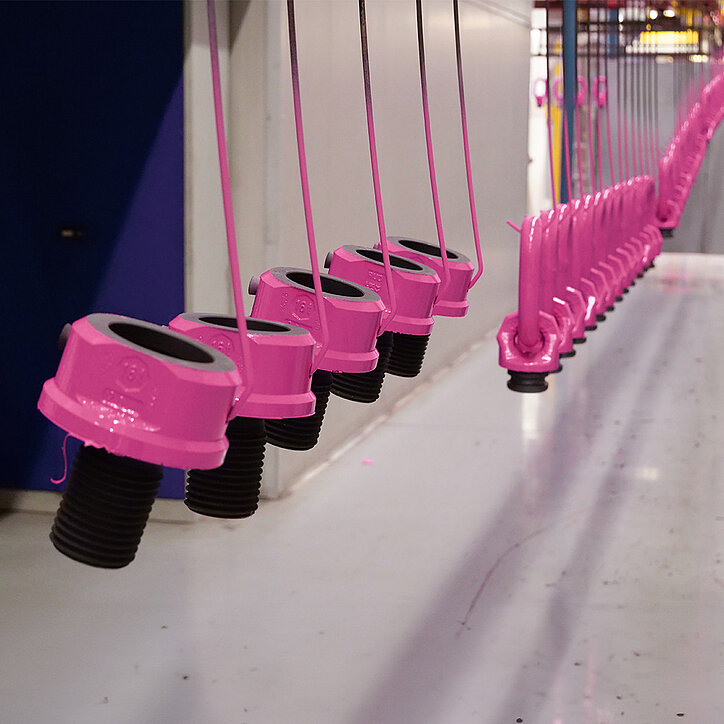
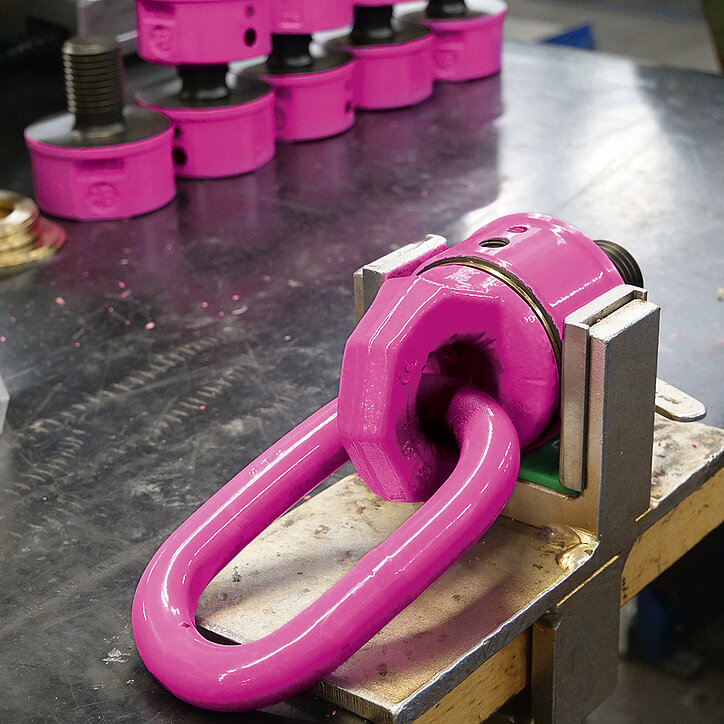
With the manufacture of the suspension links and the achievement of the final strength of all components, the main components of the VWBG load rings are essentially complete. However, before they are finally assembled, they are first given the same distinctive pink colour given to all RUD lifting means. This colouring is applied at RUD in an in-house coating plant to achieve a powder coating. The earthed components are sprayed with an electrostatically charged pink powder material that adheres to the steel workpiece due to the difference in charge. This powder coating is then baked and hardened in a furnace, forming the pink colour coating that has been the distinctive trademark of all RUD lifting and lashing equipment for over 30 years.
Final assembly: everything goes digital to finish
Once the surface coatings have been applied, the last steps follow: the final assembly of the individual components – including the ball bearing – and the insertion of the RFID transponder, which gives each VWBG load ring a unique identification number. “With this number, users can scan the product’s identification number either by using our RUD USB ID Reader or, even more conveniently, our BUDDYtron app. This allows them to access basic product information stored in a database,” explains Hermann Kolb. The digitisation of the lifting point marks the end of the production process. The final step is to carry out a functionality check. Once this process is complete, the finished load ring can leave the factory and be set to work.
Conclusion
This brief overview demonstrates that RUD exemplifies ‘Made in Germany’ manufacturing across the entire supply and process chain, from blank procurement to mechanical and thermal processing methods, coating and digitisation. This is complemented by our customer-oriented consulting, service and maintenance activities, which demonstrate our commitment to Germany as a business location as much as our production activities do. “This commitment is unshakeable for us,” emphasises Jörg S. Rieger, Ph.D., RUD Managing Director. “After all, we want to continue to uphold our dedication to quality in the future. Our customers should therefore continue to benefit from the expertise and manufacturing quality that we can only provide at our domestic locations.”